Posts Tagged ‘Facebook’

Facebook ads for MOTU?

// July 4th, 2012 // 6 Comments » // Free Software

MOTU Outreach

During the last Ubuntu Developer Summit, developer and contributor outreach was a topic that came up in a wide variety of sessions. In one of the sessions where we discussed the future of MOTU (the Ubuntu Masters of the Universe team), Evan Broder suggested that we try channels that might not necessarily be the usual geeky channels, like just taking $25 and buying some Facebook ads.

I’ve never bought any Facebook ads before and thought I’d give it a shot. I didn’t have time to prepare a nice campaign, or a nice landing page or anything fancy, but instead of putting it off until I can I decided to just run with it and see what happens.

I merely created an ad that said “Want to improve Ubuntu? Join the  Ubuntu Masters of the Universe team and help fix bug and upload packages!”. It linked back the the Ubuntu MOTU wiki page, which isn’t exactly glamorous, but it contains a lot of useful information on how to get involved.

Impressions and Clicks

Facebook lets you choose which targets you want to focus on. It even suggested a few, I mostly stuck with the defaults that it suggested and tweaked a little. This ended up being the targets:

This advert targets 129,520 users:

  • who live in one of the countries: United States or United Kingdom
  • who like ubuntu, linux or #OMG! Ubuntu!
  • who speak English (UK) or English (US)
  • who are in the category Science/Technology or the category Computer Programming
The ad was displayed a total of 20 661 times. That’s what Facebook considers it’s “outreach”. So out of the 129 520 users who were targeted, it was displayed for 20 661 of them.  59 people clicked on the link (that’s about as far as you can get with $25).

Did it work?

Well, did it get more people interested in contributing to Ubuntu? I have no idea. This experiment was mostly to see what $25 gets you in ads. Evan said he’s still up for contributing $25 for something like that, so perhaps we’ll do another round and make it more campaign like and more targeted. I’m actually somewhat dissapointed with the stats that Facebook provides. I was hoping for something more like Google Analytics where you could see where your visitors are from, which language they speak and which interest lead them to the ad. Maybe we’ll just try out Google ads next.

I actually think that it’s easy enough to target people via social networks like Google+. There are so many geeky people on there and from what I’ve seen, people are quite eager to share information that’s put together well and worth while sharing. It’s probably possible to put together a really good, effective campaign without even spending any money on it.

Any thoughts? Please share!

SociBook del.icio.us Digg Facebook Google Yahoo Buzz StumbleUpon

The “Software Packages” Meta-Track at UDS

// May 15th, 2012 // 2 Comments » // Free Software

Meta Track?

I’m glad you asked! At the Ubuntu Developer Summit, sessions are arranged by track. There are some topics that don’t have official tracks, but you end up seeing the same people in the same kind of sessions and it ends up being a track for all practical intents and purposes. One of these “meta-tracks” that emerged at this UDS was about software packages in Ubuntu. These were discussions related to how packages are organised in Ubuntu, how they’re maintained and synced with Debian, how to get upstream software developers excited about Ubuntu and more.

These were the sessions where I could walk in and be sure to find some combination of Stefano Rivera, Allison Randal, Asheesh Laroia, Evan Broder, Iain Lane, Andrew Starr-Bochiccio, Daniel Holbach, Andrew Mitchell, Micah Gersten, Bhavani Shankar and more in there :)

These sessions included:

I couldn’t attend all of them, many sessions were in the same slot or I were required in another session at the time. I marked the ones I couldn’t attend in italics.

Archive Re-organisation

I’ll jump in with the big and controversial topic. When Ubuntu was founded, Canonical and the Ubuntu community was small and could only support a subset of the Debian archives. This supported subset became known as main. Initially it was less than 1GB large, the rest of what you’d usually find in the Debian main archive became known as Universe, and a group of people, named in jest after a he-man series, became known as the Masters of the Universe (MOTU) team.

Main was maintained mostly by Canonical staff and the universe archive was maintained by Canonical staff and community members. Over time, more and more community members started to maintain packages in main. Flavours such as Edubuntu, Kubuntu and Xubuntu were later allowed to install from universe and it was later enabled by default. In the initial LTS release, only main packages were supported long-term. These days, there are many packages in universe that are supported for the full 5 years on LTS releases. Previously, only packages in main had translations shipped for them. This is also no longer true. The lines between main and universe have become so blurred that having the separation no longer made any sense. Around the last LTS release (10.04), the topic of an archive re-organisation emerged. It was a big discussion, and when the Developer Membership Board was formed the MOTU Council was disbanded (which in my opinion was a bad idea) in part of that and also in anticipation for the archive re-organisation. Some people took that as meaning that MOTU is dead or that it would stop to exist. That is certainly not the case.

Unfortunately, the archive re-organisation became very complicated very quickly. There still needs to be a way for Canonical to identify packages that they officially support if someone wants to throw money at them for supporting it. We can’t have everything translated because the language packs would just grow too big. How would we deal with managing build-dependencies and make sure that people depend on high-quality tools and libraries? Soon after the initial archive re-organisation was started, it stalled. In my opinion this caused lots of confusion and did damage to the Ubuntu project.

Having said that, I’m glad to report that the discussion at this UDS was extremely positive and it seems like the archive re-organisation might actually be completed over the next two releases. Other benefits will include how support meta-data is stored. The tools that currently use the support fields (update-manager, ubuntu-support-status, software-center, etc) will now get the support metadata from an external file, which means that packages in Ubuntu wouldn’t need a diff with Debian’s packages anymore for support meta-data. Also, the archive layout will be simpler and easier to understand. MOTU would probably change from “Masters of the Universe” to “Masters of the Unseeded”. Packages that are seeded are packages that are provided on standard Ubuntu flavours (Ubuntu Core, Ubuntu Desktop, Ubuntu Server, Edubuntu, Kubuntu, Xubuntu, Lubuntu, etc). The rest of the archive that are unseeded would then still be maintained by a newly defined MOTU group.

It’s a big hairy issue and I’ve just touched on some of the areas, but what’s great is that progress is being made again and that people are serious about making it happen. Colin Watson has a work item to take the discussion further on the Ubuntu development mailing list. I’m positive that things will be moving forward on that front for this cycle, even if it ends up taking another cycle to iron out some of the smaller kinks.

Application Review Board

In a previous cycle, Canonical put together a process by which application developers could get their non-free, commercial applications in to the Software Center via authenticated PPA. It seemed unfair to have a process where non-free software could make it into the Ubuntu software center but free software couldn’t, so a process was formed to let apps in the software center via an extras repository. This process is overseen by the Application Review Board. I joined this board right about 6 months ago. We’ve had the usual problems that Ubuntu teams have (because, in reality the ARB is more of a team than a board, the name is a misnomer, I wish less Ubuntu teams had this issue), like lack of time, getting sporadically distracted by other work, but on top of that, we didn’t have our process quite smoothed out yet. The web interface that we used to manage apps had some huge issues (like making apps completely disappear from the interface when requesting feedback from the developer).

For the last weeks, quite a few people have worked hard to help fix the issues in the process and in the web app. There were *many* sessions at this UDS regarding upstream developers, the ARB, the MyApps web interface, etc. At times I thought that there were too many, but it was just right. A lot of issues were discussed, problems were solved, and while I felt like the ARB process was in an alpha stage during the last cycle, I think it’s more like a beta-state process now. I think we’re very close to having a process that’s smooth and easy for both the people that submit these apps, and the people who review them.

Currently the ARB has some backlog that we need to sort through, we’ll probably use that to help improve the process further and make Ubuntu a fun and welcoming platform to develop for.

We also absolutely want people to contribute their software to the right place. If a package belongs in Debian, Ubuntu, a PPA or any other archive instead, we’d like to advise the user properly. I took a work item to put together a flowchart to help people decide where to submit their app, because there’s way to many guides and howtos and someone could read the entire New Maintainers Guide and still won’t know where to submit their app :)

I know I’m a bit thin on the details on the sessions here, but I’ll do more blog posts on that. I just wanted to provide some background and explain that good progress is made, and that things are greatly improving with the ARB process. In the ARB, many of us are aspiring to becoming Debian Developers so that we can help sponsor packages there when it’s appropriate.

Debian Health Check

The Debian Health Check session as become a regular session at UDS. We had a bunch of DD’s in the room that could comment on the Debian-Ubuntu relationship, but we didn’t have someone who specifically represented Debian. Some of the issues I’ve mentioned previously (like the ARB) were discussed. Also the Ayatana patches from Ubuntu that are hard to get into Debian (which includes Unity).

What is nice is that we have quite a few people who started out with Ubuntu that became Debian Developers. The relationship between Debian and Ubuntu seems quite healthy and it seems that both projects gain great benefit from each other.

MOTU Birds of a Feather

The archive-reorg was discussed, and MOTUs future role was discussed in anticipation of it. There was some discussion about things that have worked well in the last few cycles that should be revitalised. MOTU needs some more announcements of what it’s doing to cause some buzz around its activities. Too few people know what MOTU does and how it does it. Evan Broder and I plan to try some experiments with Facebook ads to see what kind of people/interest they bring in MOTU :)

The MOTU team is also very eager to get long-term ARB apps into the archive. Having apps in universe would mean less work and restrictions than having them in extras.

As MOTU we’re very committed to it and its goals, but there needs to be some restructuring/updating of the current documentation. It might also need a new vision/mission-statement, etc. This cycle is going to be a revitalisation cycle for MOTU in whatever form it will continue to exist. We hope that many people will get excited about packaging and quality in the Ubuntu archive and help contribute to that :)

Getting it all down is impossible

I wish I could do a better job at this blog post, but I’m still somewhat suffering from information overload from last week, and if I try to get it perfect and get everything in there then this post will never get finished. If you have questions, feel free to give a poke on #ubuntu-motu on freenode, there’s bound to be someone who could answer questions on any of these topics if you’re willing to hang around a bit. I still haven’t even touched on Backports, APT improvements, SRU streamlining, etc, but you should be able to find most of the information from those sessions in their blueprints. If you’ve made it this far, thanks for reading!

SociBook del.icio.us Digg Facebook Google Yahoo Buzz StumbleUpon

Can Wireless Help Develop a Silicon Cape?

// May 24th, 2010 // 2 Comments » // Free Software, Project Mayhem

The Silicon Cape in a nutshell

Cape Town is Africa’s own little Silicon Valley, or in some way at least, becoming that. We have many locals who are passionate about technology and what it can do for our country and our continent who are also completely willing to share their knowledge and help and teach others while at the same time, growing local industry. We have user groups such as the Cape Town Linux Users Group (CLUG) who provide regular talks on technical and beginner Linux topics twice a month. We also have the Cape Town Python Users Group (CTPUG), the Cape Town Ruby Brigade and the Cape Town Wireless Users Group (CTWUG) on which I’ll expand later. These are just a few of the local technology volunteer support groups we have and there are much more. There are also many technology companies that have development offices here, such as Amazon.com, Yola and Thawte (which was also founded in Cape Town). There’s always new technology and software startups all the time and there’s a few local venture capital firms that focus specifically on technology funding. A group of people who are passionate about making Cape Town more of a local Silicon Valley created the organisation called Silicon Cape, which aims to bring together local entrepreneurs and geeks to help make the Silicon Cape vision a realA large, free and open network that connects the city could do wonders for our local technology development.ity. Silicon Cape has also attracted interest from our former mayor and now the premier of our province, Helen Zille who realises how important technology is to our local economical development.

Cape Town Wireless Users Group

I joined CTWUG around 4 years ago, it used to be just small pockets of people connecting to each other, later these smaller groups were connected and today, CTWUG covers large parts of Cape Town where you can reach any part of the network from any node. It has even extended outside of the larger Cape Town area into areas such as Stellenbosch and there’s also a vibrant community in Paarl that are connected to each other and hopefully some day, directly to the rest of the WUG.

Many are quick to dismiss Wireless User Groups as networks where people just share files and pirate content. There is certainly a lot of file sharing happening on the WUG, and in some cases there will be some piracy, but as with any big network it’s almost impossible to police. The WUG does provide a lot more than file-sharing though. Across South Africa, Internet is quite expensive and in many cases, prohibitively so. We have many users that don’t have any Internet connection at home, and we don’t explicitly provide any Internet access on the network. Instead, some users run Internet-like services on the WUG. So some users who do have an Internet connection will do things like run an email server that allows users to send and receive e-mail to the rest of the WUG as well as the rest of the world. There’s also a Jabber server that federates with other Jabber servers on the Internet. I run a few services myself. There’s CTWUG Statusnet which is a Statusnet installation that brings microblogging to the WUG, there’s Wugtube which hosts user uploaded video content and also a Big Blue Button installation for video conferencing and chatting. Besides the 3 services I host there’s lots of other services hosted on the network which includes a Facebook clone, a Teamspeak server, many gaming servers, personal wug sites and repositories and CD images for many Linux distributions as well as Windows and OSX updates.

The wug certainly can’t replace an Internet connection completely, but it works great as a secondary network to the Internet and also for people who simply can’t afford an Internet connection. Even for those who do have an Internet connection, there’s still a lot of benefit to getting connected. By installing system updates, for example, you would only get about 419 KB/s on DSL (or at least, that’s what I get on my 4mbps line which is Telkom’s current fastest offering) while installing from the WUG would typically give you up to 1.2 MB/s (and even more) depending one your location and the mirror you’re using. Currently we only have around 500 people actively using the WUG. One of my personal goals is to get schools involved. We have a few hundred schools in Cape Town and most of them have no Internet or often, they have to share a 3GB monthly package among the whole school that typically only the admin staff and some teachers will have access too. Hosting mirrors of Wikipedia, Wikinews and other useful sites, along with the usual WUG services could have great impact for these schools in my opinion. There’s a seperate project for connecting schools together called Schoolwan that connected 35 schools to each other and to a centralised server for content, mail, etc. Even though it’s a really, really cool project, I believe that it would’ve been a lot better if it had decent funding and if the benefits of using a network such as this could be properly introduced with some good cultivation. With CTWUG schools could gain some benefit of connecting to an existing network with existing infrastructure and a large volunteer community. CTWUG has strict rules about pornography and adult content and users who share any such content publicly on the networked are disconnected without any warning.

There’s also a local project called Wizzy Digital Courier which started off as a Sneakernet e-mail service where schools could carry around their e-mail on USB disks and sync up using UUCP. With the Wizzy project also came the concept of a Wizzy server, which would dial-up after 19:00 when phone calls are cheaper and gets the content requested during the day and stores it in a wwwoffle proxy so that users could visit the websites they have requested the previous day. Many Schoolwan schools also had a Wizzy server. One idea is that some of the more resourced schools who have uncapped DSL could share their off-peak bandwidth to get and cache some data for the less-privileged schools using something like a Wizzy server.

There’s a lot I’d like to say on the topic and I’ve only touched a few things here, the point that I’d like to get to is that wide-area wireless networks can be extremely useful in areas where Internet is either slow or expensive, and probably too even so when a good Internet connection is available.

Cape Town to get City-wide Wireless

ITweb reports that there are plans to roll out fiber-backed wireless throughout the city. A R400m (about €41.2m) plan to roll out this fiber network was planned when Helen Zille was still the mayor of Cape Town. This alone will save the city about R90m a year in costs to Telkom and other operators to our municipalities.

There’s little information available on who will be able to access the network or with which networks it will peer with, but it has great potential and I hope that it will grow in to a network that will add value to as many people in the city as possible.

SociBook del.icio.us Digg Facebook Google Yahoo Buzz StumbleUpon

7 Days

// April 22nd, 2010 // 1 Comment » // Free Software

It’s just one week away! If you still haven’t added your countdown banner yet, it’s not too late! There’s also a Facebook app if you’d like to add it to your profile.

SociBook del.icio.us Digg Facebook Google Yahoo Buzz StumbleUpon

Antifeatures at Geekdinner Cape Town

// April 1st, 2010 // 2 Comments » // Free Software, Project Mayhem

Tuesday evening I attended Geekdinner Cape Town again, the food was good and it was a nice crowd.

Antifeatures

I did a mini-talk on Anti-features. It’s something that I’ve been aware of for a long time but never quite put a label on it. Benjamin “Mako” Hill coined the phrase anti-features and presented it at LinuxConf Australia 2010, I watched the video and thought that it would be a great topic for a Geekdinner.  Geekdinner talks are supposed to be only 5 minutes long, so I tried to get Mako’s ~45 minute talk down to about 6 minutes for the talk. I think it was a bit longer, I went first instead of last so I don’t think it was much of a problem. I haven’t given a talk in ages so I’m quite out of practice, but everyone who talked to me about it afterwards said that they enjoyed it and that it was interesting, so I feel good about it. It’s also one of the few Geekdinner talks that didn’t have any mention of Facebook or Twitter, so I gave myself another 50 points for that :)

You can get Mako’s slides and slide notes from his website, and also the video (which I recommend watching). You can get my slides right here. Stefano took video footage, I’ll paste a link to it once it’s processed.

TrustFabric

Joe Botha talked about TrustFabric, his joint-venture with Jonathan Endersby and I believe someone else too where they want to change the way everyone works with personal information. More information on that in these two blog posts.

How to ruin people’s lives on-line

We still needed a 3rd talk so Ben Steenhuizen threw together a talk on how bad people (which he protests heavily that he’s not) can abuse your public data and can make things very difficult for you.

Overall one of my favourite geekdinners, I’ll probably go to the Montreal Geekdinners when I get over to Canada (still waiting on Visa), but I’ll probably be back to catch one of the last Cape Town Geekdinners again towards the end of this year.

SociBook del.icio.us Digg Facebook Google Yahoo Buzz StumbleUpon

UDS Sessions attended today

// May 25th, 2009 // 2 Comments » // Free Software, Games, Jonathan, Politics

The sessions are quite short, most of them just under an hour which works quite well, most sessions have follow-up sessions planned. Refer to http://summit.ubuntu.com/uds-karmic/ for further details.

Improving LoCo Team Events

This was the first session I attended today. We discussed package and bug jams and how it could be improved. Also the possibility of introducing marketing jams where users would get together to produce local marketing content such as posters, CD covers, etc in local languages. A requirement was identified for a Facebook-like events engine. Currently loco-teams are finding Facebook a handy tool for this, and something similar may be included in Launchpad for all Ubuntu related events based on the current sprints scheduler. The community directory is 98% complete, Jono will provide us with more details soon when it’s just about complete.

Refocusing The Ubuntu Spirit

This was mostly a discussion that went into various different directions. The Ubuntu Code of Conduct came up and it was discussed how new users sometimes are a bit too diligent trying to enforce it on everyone else in the community. It was agreed that the CoC is a guideline on how people should conduct themselves and that it shouldn’t be used to through books at people, so to speak. Keeping users and developers motivated was also discussed, and the possibility of some kind of showcase of success stories from users around the world.

Free Culture in Ubuntu

Getting free culture on the Ubuntu discs is hard due to the lack of free space. Free culture could be provided in Ubuntu via links and default subscriptions in Firefox, Liferea, Miro etc.

Tutorial on Upstart and How to Convert to it

Scott James Remnant did an introduction on Upstart. Upstart replaces Init on Ubuntu and migration for all init scripts to Upstart is planned for Karmic. Upstart is quite nifty and replaces lots of duplicate and error-prone work that package maintainers had to implement in init before. You can specify environment variables or put entire scripts into the sections before, during and after a process is started. Upstart also keeps an eye on the list of PID’s that it spawned and won’t break when a user does something like execute “apache2ctl stop”.

Meet Your Users

This was a workshop/discussion about personas, archetypes and stereotypes and how personas are used to define the edges of our user universe. We wrote down who we think our users are and they were posted up the board and sorted in to different groups. I think this was the first BoF I’ve ever attended that was led by a women. Speaking of which, there are much more women attending this UDS than previously. One of the results seem to be that there’s some more attention given to some of the more softer issues in Ubuntu. Hopefully it also means that our community has built a good reputation of being welcomming and mature.

Edubuntu Session Tomorrow

Tomorrow at 9:00 UTC (11:00 in Barcelona) we’re having the Edubuntu session where we’ll discuss the Edubuntu stategy document, it’s been in draft for a while and we will hopefully have it finilized very soon (maube even tomorrow if we’re lucky). Some people couldn’t make it, so we’ll try to keep #edubuntu in sync with discussions if the Internet holds up.

SociBook del.icio.us Digg Facebook Google Yahoo Buzz StumbleUpon

What is dented!?

// May 11th, 2009 // 9 Comments » // Free Software

Recently, when I run into people I haven’t seen in a while, the number one question I’m asked is “What is dented!?”

I then wonder for just a split second what they mean and then I realise they’ve seen it on my Facebook statusses:

facebook-status

Before I can explain what “dented” means, I should explain the concept of Microblogging. Twitter is probably the most biggest and most widely known microblogging service. The idea is that people post short status updates (140 characters or less) called “tweets”. When millions of users post their tweets, it starts to resemble an on-line version of a tree full of birds making a lot of short noises. When you look at the big picture, and look at what the current top tweets are, it becomes a powerful tool to track trends and to find out what’s going on in the world. Twitter also supports tags and groups, which provides more functionality in terms of tracking tweets and finding other users.

twitter

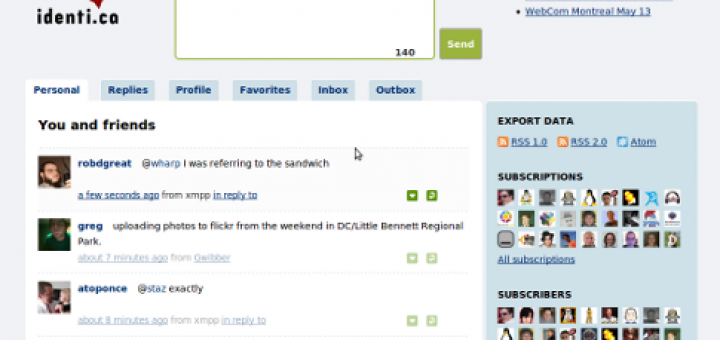
Twitter became imensely popular, and it’s one of the biggest social networking sites on the Internet today. Following its success is Laconica, which is completely open source microblogging platform software. The first major site to implement a Laconi.ca site is Identi.ca. Initially, users called their messages “tweets” just like you do in Twitter, but then some clever users started to call their messages dents, they also often say “I dent!” when someone makes a Twitter reference (where “I dent” is the first 5 letters of identi.ca). Identi.ca is probably the most popular Laconica driven service currently, and it’s widely used by free software advocates.

identica

Karl Fischer has set up another Laconi.ca service specifically for FLOSS (ugh I hate that term) professionals called floss.pro, which provides more focus than Identica.

flosspro

Other South Africans have also jumped on the bandwagon, the guys at Afrigator have written their own microblogging service called Gatorpeeps. I joined today and tried it out, I think it’s quite well done comparing it to Twitter and considering that it’s still such a new service.

gatorpeeps

That’s basically the microblogging sites I have accounts on. It would be daunting to update all of them individually, so I use a service called Ping.fm to send the updates to all my microblogging sites. It’s handy when I’m at someone elses computer or a public computer and I want to send a quick update out to all my services.

pingfm

When I’m using one of my own computers, I run a tool called Gwibber, which fetches the updates from the people I follow, and when I post my updates in Gwibber, it gets syndicated my update to all the tools I use that supports status updates.

gwibber

In Facebook, I have the Identi.ca application installed, so when Gwibber posts an update to Identi.ca, the application posts it to my Facebook status as well, and that’s where “jonathan dented:” comes from. I hope that clears it up :)

People also do all other kind of things with microblogging. Some people even connect things like washing machines to twitter and let them tweet when they’re done with their jobs: http://www.engadget.com/2009/01/03/washing-machine-hacked-to-tweet-when-the-loads-done-maytag-y/

One person has even managed to tweet his way out of jail: http://www.cnn.com/2008/TECH/04/25/twitter.buck/

Many people are sceptical about microblogging, but as the concept matures, the value and the applications become more apparent.

SociBook del.icio.us Digg Facebook Google Yahoo Buzz StumbleUpon